Targeted to Intermediate English (B1+) speakers.Read more
This is the standard requirement for most courses. Participants at this level can participate actively in discussions and manage everyday and professional situations. If they are unsure about their English level, they can test it here or explore our courses facilitated in Basic English.
Cross-Curricular.Read more
The listed audiences are those for whom the course is especially recommended, but courses are not exclusive to them and are open to everyone. In fact, most of our workshops are built around the collective sharing of participants’ experiences and having a variety of profiles enriches the learning process and is highly encouraged!
Description
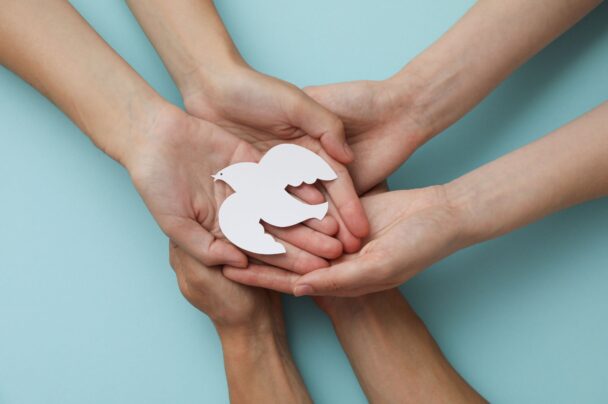
Peace is not simply the absence of violence, but the presence of empathy, understanding, and the courage to resolve conflict constructively.
Educating for peace can guide us to shape a brighter future of a more just, democratic, and sustainable society, and in nurturing these capacities in the next generation, schools play a key role.
This course draws inspiration from Finland, a country that has learned how to transform conflict into a culture of equality, trust, and democracy through education and community engagement.
During the course, participants will be introduced to Finnish peace education approaches, and they’ll learn how these can be adapted to diverse European contexts to reinforce democratic values, well-being, and inclusion in schools.
Participants will explore peace as a holistic and active process that begins with inner balance (“peace within me”) and extends to interpersonal relationships (“peace among us”), and finally culminates in civic engagement (“peace in the world” and “peace in action”).
They will engage in experiential learning through discussion, drama, and art-based workshops. Also, they will foster personal inner peace and resilience, practice critical thinking and non-violent communication, and explore creative and participatory ways to facilitate constructive dialogue, such as forum theatre.
Throughout the week, participants will reflect on how to bring peace education into their teaching, counselling, or community roles.
They will learn how to design their own Peace Action Plan, a practical roadmap to promote resilience, empathy, and democratic participation in their schools and communities.
Also, through the pedagogy of hope, participants will discover different ways to strengthen hope and empower young people.
By the end of the course, participants will have a renewed understanding of what peace education really means, both as a mindset and as a methodology, and they will leave equipped with Finnish-inspired tools and strategies that enrich and support their peacebuilding work.
What is included
Learning outcomes
The course will help participants to:
- Understand the key concepts, goals, and frameworks of peace education, with a special focus on the Finnish approach;
- Develop self-awareness, emotional regulation, and resilience as foundations for peaceful teaching and leadership as peace educators;
- Practice constructive dialogue and non-violent communication to prevent and transform conflicts in educational settings;
- Reflect on issues of power, equity, and inclusion within schools and society, and explore ways to promote democratic participation;
- Use creative and participatory approaches — such as forum theatre, art-based learning, and group dialogue — to cultivate empathy and cooperation;
- Design and share practical action plans to foster peace, empathy, and global responsibility in their own contexts.
Tentative schedule
Day 1 – Introduction to the course
- Introduction to the course, the school, and the external week activities;
- Icebreaker activities;
- Presentations of the participants’ schools.
Peace education: why, what, and how?
- What is peace? What is peace education, and why is it important today?;
- What are the frameworks and approaches of peace education?;
- Group reflection: connecting peace education to participants’ local contexts.
Day 2 – Peace within me
- Developing self-awareness, resilience, and emotional balance as peace educators;
- Practising self-regulation and self-care to foster sustainable peacebuilding capacity;
- Exploring personal beliefs, values, and social identity;
- Reflection workshop: understanding privilege and responsibility in education.
Day 3 – Peace among us
- Understanding the roots and dynamics of conflict through critical thinking;
- Transforming conflicts through non-violent communication;
- Creating safer and more inclusive learning spaces;
- Interactive workshop: analyzing power structures and group dynamics.
Day 4 – Peace in the world
- Examining power structures in society and how prejudice and stereotypes sustain inequality;
- Workshop: dialogue facilitation and conflict resolution through forum theatre;
- Art for Peace – exploring artistic expression as a tool for empathy and understanding.
Day 5 – Peace in action
- The Finnish Pedagogy of Hope: empowering youth as peacebuilders;
- Designing peacebuilding action plans for schools and communities;
- Presentation and peer feedback on participants’ projects;
- Closing reflection: sustaining peace education beyond the course.
Day 6 – Course closure and cultural activities
- Course evaluation: round-up of acquired competencies, feedback, and discussion;
- Awarding of the course Certificate of Attendance;
- Excursion and other external cultural activities.
Download or share
Add to favouritesGet weekly recaps on confirmed sessions!