Targeted to Intermediate English (B1+) speakers.Read more
This is the standard requirement for most courses. Participants at this level can participate actively in discussions and manage everyday and professional situations. If they are unsure about their English level, they can test it here or explore our courses facilitated in Basic English.
Cross-Curricular.Read more
The listed audiences are those for whom the course is especially recommended, but courses are not exclusive to them and are open to everyone. In fact, most of our workshops are built around the collective sharing of participants’ experiences and having a variety of profiles enriches the learning process and is highly encouraged!
Description
Teachers today face a significant increase in challenging student and parent behaviours, ending up with very high levels of work-related stress.
These demanding situations involve conflict, challenging behaviour, and difficult communication with students, parents, and colleagues.
For these reasons, there is an urgent need for educators to master strategies that ensure physical safety and emotional regulation while maintaining the “human” element in high-pressure school environments.
This course explores practical strategies for conflict de-escalation, emotional self-regulation, and restorative communication in educational settings.
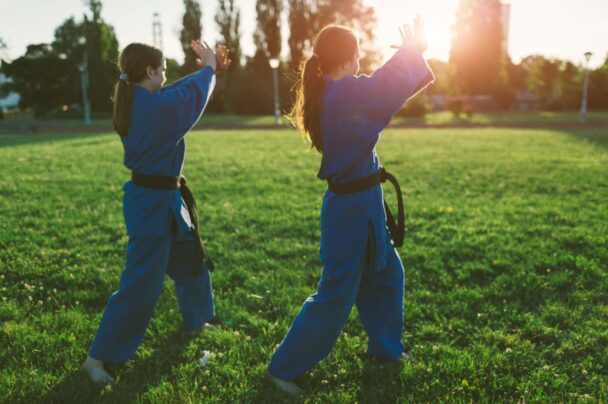
Inspired by principles drawn from Aikido, it will introduce participants to a series of reflective movement-based practices and practical disengagement skills that will provide educators with a toolkit for preventing escalation and exiting volatile situations safely without causing harm.
During the course, participants will learn how to recognize stress responses, regulate emotional reactions, and create safer, calmer interactions during tense situations.
They will learn non-verbal communication drills, restorative conversation protocols such as “forced listening,” and physical mobility exercises focused on safe exiting and protection.
Each activity is designed to transition educators from a “fight or flight” response to a state of calm authority and receptivity.
Through practical activities, guided reflection, and movement-based exercises, participants will explore how posture, breathing, non-verbal communication, and listening strategies can influence classroom climate and interpersonal dynamics.
By the end of the course, participants will have acquired the competence to neutralize aggression through circular movement, set clear non-verbal boundaries, and apply restorative techniques to mend relationships after a conflict.
Finally, educators will leave having gained a deeper sense of self-control and the physical confidence to maintain a supportive and safe classroom environment.
What is included
Learning outcomes
The course will help participants to:
- Master emotional self-regulation to move from a sympathetic to a parasympathetic nervous system response during stress;
- Use breathing, grounding and movement-based techniques to maintain calm and focus under pressure;
- Apply Aikido principles of non-resistance and circular movement to redirect and neutralize verbal or physical aggression;
- Utilize de-escalation communication tools like “stress reappraisal” and “thought records” to maintain professional focus;
- Execute safe disengagement skills, including Tenkan (turning) and Ukemi (safe movement), focused on protection and exiting;
- Facilitate restorative conversations using principles of “emotional compensation” and “switching positions” to resolve deep-seated conflicts;
- Develop practical approaches for creating calmer and more supportive classroom environments.
Tentative schedule
Day 1 – Introduction to the course
- Introduction to the course, the school, and the external week activities;
- Icebreaker activities;
- Presentations of the participants’ schools.
Prevention and the “state” of the teacher
- Understanding stress responses in educational environments;
- Breathing for Authority: Moving from “fight or flight” to “relaxation and receptivity”.
Day 2 – Non-verbal communication and de-escalation
- Introduction to Aikido-inspired principles of non-resistance and balance;
- The “Way of Peace” and neutralizing attacks without harm;
- Mastering non-verbal communication and “emotional control” to navigate emotionally charged environments;
- Practical drills on “exiting” a situation when physical or emotional boundaries are crossed, aligned with school policies.
Day 3 – De-escalation communication
- Active listening and emotionally aware communication;
- Implementing the 5-4-3-2-1 grounding technique to remain present during verbal escalations;
- Implementing the “forced listening” principle where the “opponents” must repeat the other’s last remark before responding;
- Workshop: Responding constructively to emotionally charged situations.
Day 4 – Restorative conversations
- Principles of restorative communication in schools;
- The “Switching Positions” exercise to build empathy and de-escalate long-term tensions;
- Group discussion: creating respectful and emotionally safe school environments;
- Reflection activities and collaborative problem-solving.
Day 5 – Safe disengagement and exting skills
- Creating a 20-30 minute “After-School Reset” routine (walking or mindful movement) to process physical stress and create a work-home boundary;
- Review of de-escalation, disengagement, and restorative skill;
- Using “Standing Qigong” (Zhan Zhuang) to build physical rootedness, stability, and spatial body awareness;
- Peer feedback and reflection.
Day 6 – Course closure and cultural activities
- Course evaluation: round up of acquired competences, feedback, and discussion;
- Awarding of the course Certificate of Attendance;
- Excursion and other external cultural activities.
Download or share
Add to favouritesGet weekly recaps on confirmed sessions!